Kemsley Down, 2046
Written by our Writer-in-Residence at Sittingbourne Steam Railway, Dan Thompson
Written by our Writer-in-Residence at Sittingbourne Steam Railway, Dan Thompson
The dark red-brown sails of The Arcadian seemed to be perfectly still against the horizon, but he knew that really the barge was moving – slowly, steadily, coming closer. In an hour or so, she would be moored at Kemsley Down wharf. A floating market, The Arcadian carried an ever-changing cargo of things collected on the boat’s journey across the Channel, and along the southern edge of the Thames Estuary, from the semi-autonomous Isle of Thanet and down the North Kent coast. The last port of call had been Whitstable where she would have taken on Whitstable Natives, good rope, and fresh bread, to sit alongside the vegetables and salads from the huge greenhouses at Thanet Earth, and the bowls, cups, and plates from the cluster of small potteries at Margate.
At Kemsley Down she would load up with reams of paper and piles of flat-packed cardboard boxes from the paper mill. She’d also take on an odd assortment of goods made in the railway’s engineering works just up from the wharf – metal coat-hooks, hand-painted numbers for front doors, doorstops made from old sleepers, a miscellany of useful and well-made things. The works provided specialist services to other similar railways – Sittingbourne’s team was well respected for restoring locomotives and refurbishing wagons for the growing number of light railways around the country. But the railway’s employees and volunteers had a good sideline in making smaller items, often made from the leftovers of larger projects. And the works were used by other artisans and artists too, for fabricating one-off items or making sculptures. Often, part of the pay-off for using the space was donating something to sell in the works’ shop.
So at the end of the day The Arcadian’s buyer would negotiate a good load of whatever the works had, filling the gaps after the day’s customers had been. Before sailing to Sheerness, then down to Rochester to load with goods brought along the old Roman road from London, to take back to the continent. Things made here would find new homes in the Netherlands or Northern France.
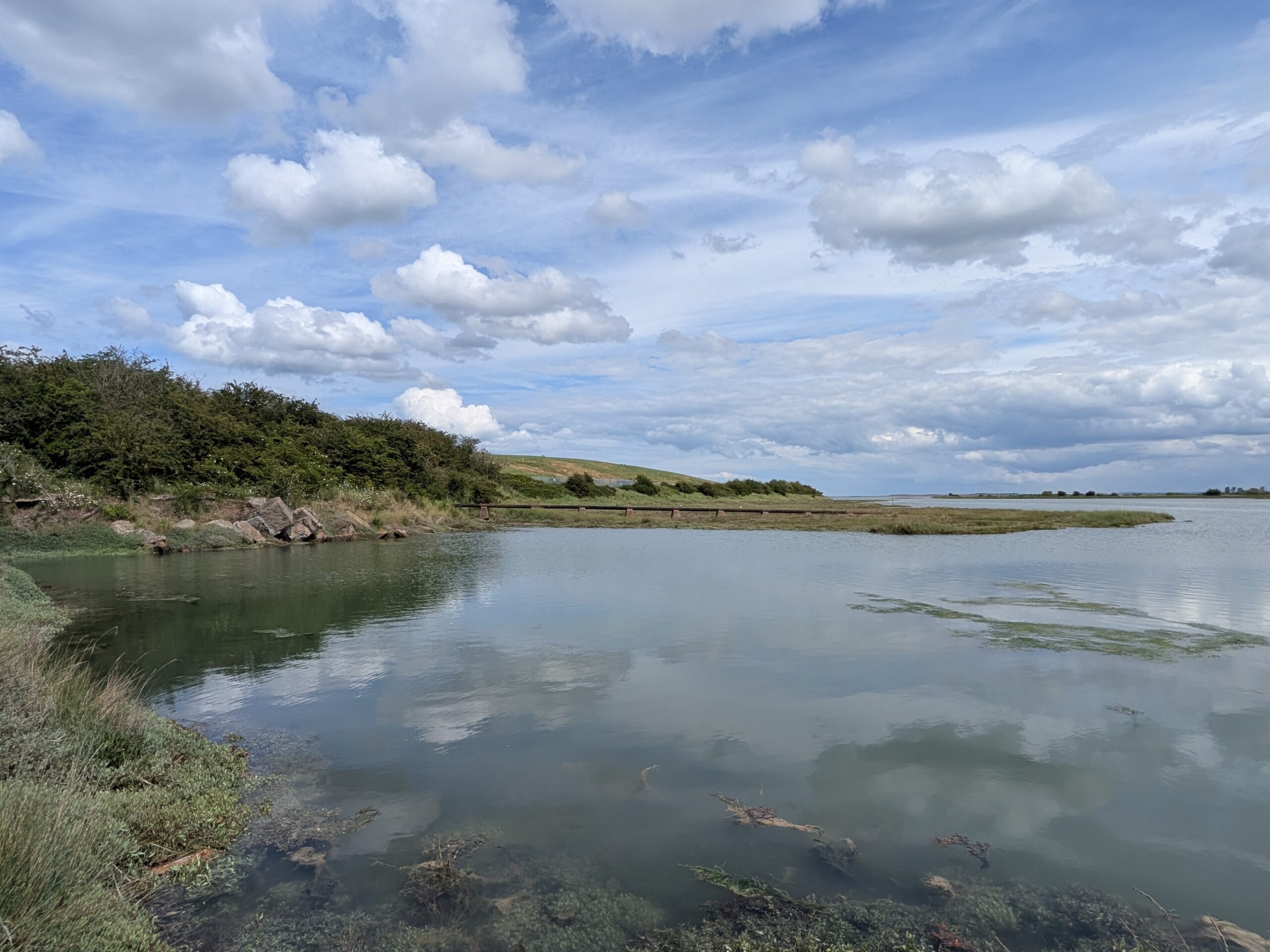
He remembered, twenty years ago, that you could walk down here, to the bottom of the railway yard, and come through a hardly-used gate to look out over nothing but dirty, pollution-stained salt-marsh. Muddy creeks with trickling water, the snap of insects, and the sound of dozens of small wading birds. But now the water was always high. The sea levels had risen as predicted, almost imperceptible year-on-year, and the water was always here. At the edge of the ten-year-old New Seawall that local volunteers had constructed from biochar-cement to make a new wharf and protect the railway at the same time. There were still birds; gulls and terns, cormorant and geese, Sanderling and Turnstone, and a single Grebe. A Sea Eagle, high up in the distance But no mud, just flat still water reflecting blue sky.
Now, the steam railway faced onto Milton Creek proudly, where it had once fenced it off and largely ignored it. The wharf had helped re-orientate the railway yard, of course. As well as the monthly visit from The Arcadian, other trading boats often stopped here, more specialist traders like the floating bookshop from London and the haberdashery barge out of Ramsgate. Leisure craft would often moor here overnight, or for a few days, and use the railway yards facilities, the laundry and the shower rooms. So the bustling mooring, always full of coming and going, was a natural focus.
But the railway’s visitor centre looked out over the water too, with wide views even when there were no boats in the foreground. The Station Shed cafe on the first floor, above the museum, was a popular spot with its broad balcony looking over Milton Creek, views across Barley Bank to the marshes on the Isle of Sheppey. Cafe by day, in the evenings it hosted live music, literary readings, travelling theatre companies, or visiting chefs who would create pop-ups pulling an audience from across the area. People would catch the mainline train to Sittingbourne or drive and park there, catch the steam train from Sittingbourne Viaduct, and spend the evening at the visitor centre. Events here were always popular, whatever the season, storm-watching as much an attraction as hot summer evenings.
There was the sound of a steam whistle behind him. The 140-year-old Premier was working today, and now – an hour before the hot noon – she was ready for her first run. The earlier trains, services running daily on the half hour from 8am, would be the diesels converted to run on bio-fuel, leaving a smell like chip shops as they headed up the line to Sittingbourne. Or one of the pair of battery locomotives, charged by the solar fields just north of the yards.Power here was never a problem. If the solar fields weren’t producing enough, the paper mill’s huge biofuel power plant would supply more than enough for these little battery trains to carry visitors, staff, and residents between the works, the village at Kemsley, and the bigger neighbouring town.
And today, with The Arcadian due in, Premier would be full of shoppers on the first journey back from Sittingbourne. Some would have The Arcadian’s monthly visit in their diaries and be regulars.
Others might have special orders to collect, loaded onboard the boat at an earlier stop. Thanks to the efficient timetables of the trading boats, you could order most things and have them delivered within a month.
Some would come,of course, just for the experience. While the trading boats were providing a vital service for the smaller coastal communities, some people from the larger towns, that still had the remnants of supermarkets and easier access to goods, just liked the novelty of steam and sail. They would take more photos than anything else, but would inevitably buy something from the railway’s shop as a souvenir.
With Premier about to head to Sittingbourne, and The Arcadian coming ever closer, he knew it was about to get busier at the yard. So he turned away from the water, ready for the job of work ahead of him. He had one last thing to do, in the railway’s print room, before delivering them to the museum’s shop – folding and stapling the latest collection of letterpress-printed Stories from Sittingbourne Railway.